Showing posts with label Kenya. Show all posts

Thursday, 11 September 2014

GUEST POST: Community Paralegals and the Legal Empowerment Approach to Statelessness

Mohammad Javed is an Urdu-speaking entrepreneur living in the middle of Dhaka, the capital city of Bangladesh. Looking to grow his business, Mohammad decided to travel to India to start importing spare auto-rickshaw parts for his own repairs and to sell to others. Yet Mohammad was unsure of the process through which he could obtain a passport. He was also intimidated to approach the passport authority office. While a landmark 2008 High Court judgment confirmed Urdu-speakers’ Bangladeshi citizenship and ended their 40 year struggle with statelessness, Mohammad had heard stories of fellow Urdu-speakers being denied passports due to their identity and residence in urban “camps” established by the ICRC after Bangladesh became independent in 1971.

A continent away, Yusuf is a 19-year-old of Nubian ethnicity living in the Kibera slum outside Nairobi, Kenya. Yusuf wanted a birth certificate to access basic services and to reinforce his identity as a Kenyan citizen. For three months, he tried to apply for a birth certificate on his own. He repeatedly went to the relevant government office, which required a trip into town, but each attempt to apply was met with harsh treatment and requests for additional supporting documents beyond those required of most Kenyans. After many failed attempts, Yusuf gave up on getting a birth certificate.

Both Mohammad and Yusuf belong to minority groups that are either emerging from a protracted situation of statelessness or are at risk of statelessness due to difficulties in acquiring legal identity documents like ID cards and passports.  Despite laws and court decisions that establish their citizenship rights, lack of legal knowledge, complex application procedures, and a lack of proper implementation of the law – sometimes outright discrimination – all stand in the way. 
How, then, can Mohammad, Yusuf, and the millions of others like them around the world protect their rights as citizens – obtaining legal identity documents that allow them to prove their nationality, obtain employment, travel abroad, open a bank account, or enroll in school?

Community-based paralegals, also known as grassroots legal advocates, can bridge the gap between law and real life. They use knowledge of law and government, and skills like mediation, education, organizing, and advocacy to seek concrete solutions to instances of injustice. Paralegals not only work alongside clients to resolve a legal issue, but also focus on empowerment -  leaving each client in a stronger position to deal with similar problems in the future.
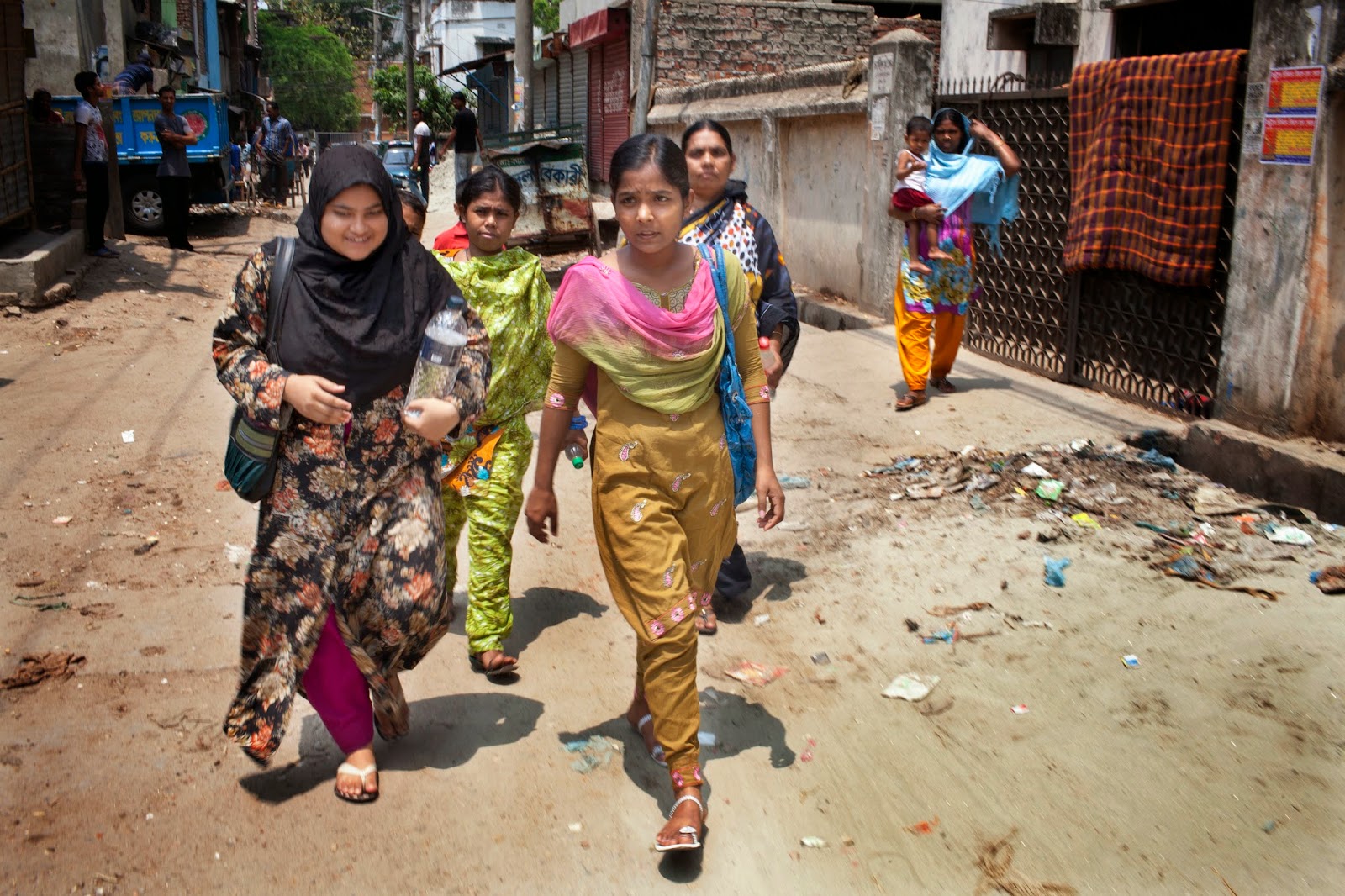
In Bangladesh, paralegal Nahid Parvin from the Urdu-speaking community
accompanies a client to a Government registration office
Namati, an international legal empowerment organization, is dedicated to the paralegal approach. Since 2013, Namati has been working with Nubian Rights Forum and the Open Society Justice Initiative (OSJI) in Kenya and with the Council of Minorities in Bangladesh to train and support paralegals in communities emerging from or at risk of statelessness.

The Nubian paralegals in Kenya and the Urdu-speaking paralegals in Bangladesh start by educating their communities about the importance of legal identity documents, the eligibility requirements and application processes.

Some people use that information to apply on their own. Others require additional assistance – help with forms, or a paralegal to accompany them to the registration office.  Sometimes the paralegal’s presence alone will make an official think twice before making extra-legal requests. And when an official delays or denies a client’s application for an identity document, the paralegal is there to use the law in negotiations and follow the case through to a resolution.

In the past 18 months, Nubian Rights Forum paralegals have opened over 1,200 cases and several hundred clients have already received their identity documents. In Bangladesh, more than 1,400 Urdu-speaking clients have received identity documents in just one year.

Yet the paralegals supported by Namati and its partners are not only concerned with assisting individual clients. The paralegals are tracking every case to establish an evidence base on how laws are implemented. By analyzing hundreds of cases, the data can be used for high-level advocacy.  Improvements to the law and practice can create change not only for Kenyan Nubians or Urdu-speaking Bangladeshis, but potentially ease access to legal identity documents to all citizens in these two countries.

And as this model of citizenship-focused paralegal services develops, practical resources and lessons will be shared with like-minded organizations, illustrating how community-based justice services can respond to or prevent statelessness around the globe.

This Guest Post was written by Laura Goodwin, Program Director at Namati (www.namati.org). She manages Namati’s Burma Program and Citizenship Program, which is active in Bangladesh and Kenya. She is speaking at the Global Forum on Statelessness on Monday 15 September.

Saturday, 20 April 2013

Stateless people and microfinance institutions


I recently had a conversation with Professor Thorsten Beck from the Department of Economics here at Tilburg. Our conversation lead to some interesting areas of how microfinance and its relatedness to statelessness. In this post I want to explore some of these, specifically how micro-finance schemes could be a means by which we can start addressing the lack of income security faced by many stateless people. While work is done on resolving statelessness through legal reform and naturalization we have to consider that protracted stateless situations require alternative strategies to overcome some of the hardships faced by many stateless people while their status is being resolved. This period of resolution can become significant with some people living their whole lives without a nationality. Restricted or no access to financial services, such as bank accounts or loans, has been noted as one of the major difficulties faced by the stateless. Microfinance institutions (MFIs) with their alternative banking, credit and insurance services can be, and have been, designed to overcome some of the barriers and obstacles that are shared by low income and disenfranchised groups (which includes some stateless).

MFIs are normally associated with the provision of financial services to low-income individuals as a means to allow them to lift themselves out of poverty. Despite critique such schemes have received growing interest over the last several decades and have been shown as one path to making financial markets work better for the poor. How alternative financial services could facilitate access for impoverished stateless persons and communities has however received little attention. I will draw on three areas where MFIs and related initiatives have been used to assist the poor with issues that also affect the stateless.

Firstly, the lack of any form of ID is a barrier to basic financial services such as opening bank accounts, transferring money, and accessing credit and insurance. The Credit Reference Bureau of Uganda found that, as no national ID was provided by the government, those who did not hold drivers licenses, passports or land deeds etc. found access to financial services problematic. With those holding ID not seen as the poorest members of the country as their lack of ID reflected their lack of resources (land, property, ability to earn an income through driving etc), alternative bio-data and unique numerical ID solutions were found. Other methods such as basing schemes on community cooperation and trust have also proven useful and could be implemented for both concentrated stateless populations and those who are dispersed, but embedded within the local community.  Such schemes would avoid the need to formally register the stateless receiving financial benefits, which is complicated, expensive and/or requires political will/cooperation. 

Secondly, phone banking has proved popular and successful in Kenya as a means to facilitate easy, affordable and accessible financial services. For stateless populations this could mean the easy transfer of money between dispersed families and communities, remittance facilitation, and transfer of funds to difficult to reach populations (both physically and politically) from MFIs and non-governmental organizations. Without access to bank accounts and the problematic nature of transferring money without ID cards, phone banking could provide a solution.

Finally, the provision of financial services to the poor, or making these services more accessible, can be seen as an individualized response. By that I mean that MFIs can circumvent some of the political issues of providing financial services to stateless populations by basing their services on need alone. This could manifest itself by providing these services through international organisations rather than the local government. In situations where the government refuses these services to the stateless - as non-citizens - this could be one path to reducing the impact of protracted statelessness through a measure of income generating schemes. This makes it possible to give real content to the international commitment to address the fundamental protection needs of stateless people, while a solution to their situation is found (a process that can take decades , or generations).

Lack of any form of ID, lack of access to financial services and the at times politicised nature of government provision of financial services has been overcome for impoverished communities in countries around the world. This can, and should, be explored more closely with a view to extracting relevant good practices that can be extended to the stateless more broadly. This would not only allow the stateless to lift themselves out of poverty, but also begin to challenge the assumption that granting or restoring nationality to stateless populations would be a burden or drain on a state’s resources. While we still have to consider other barriers that will influence the success of MFIs for the stateless, such as contexts of deep seated socio-political discrimination, lack of freedom of movement and lack of economic rights such as property ownership or access to the formal labour market, we should not forget the appropriateness of MFIs for the stateless. Economic empowerment could also potentially open new doors to more comprehensive solutions to statelessness by increasing the integration and participation of affected individuals and groups within the wider community. While not wishing to devalue the call for the stateless to be granted citizenship, we also have to consider that the poverty caused by the protracted situations of statelessness has to be tackled. MFIs have proven adaptable to overcome many of the barriers faced by the stateless for other disenfranchised groups. The discourse of MFIs should include the stateless as the short, medium and long term development of income sustainability for impoverished stateless groups is as important as finding a solution to their statelessness.  

The Stateless Programme is going to dig into some of these questions a little further and we would love to hear from microfinance experts who have information or insights to share.

Jason Tucker, Visiting Scholar, Statelessness Programme

Thursday, 11 April 2013

GUEST POST: Stories of Statelessness - Burma, the Dominican Republic and Kenya

What would you do if you were a citizen of no country? If the place you were born disavowed your tie there? For the 12 million people who are stateless worldwide, this struggle for a homeland and all the rights that being a citizen somewhere entails, is all too real. Stateless people are not quite refugees; they may have lived in a country for generations, but they are denied citizenship and rights by governments who insist they belong somewhere else. Yet this global crisis is under-reported in mainstream outlets. For photographer Greg Constantine, statelessness "is one of the most complex, politically sensitive and devastating human rights issues most people don’t know about.”

In the Pulitzer Center on Crisis Reporting iBook In Search of Home, Constantine and reporter Stephanie Hanes teamed up to try to shed light on a global phenomenon. They examined statelessness in Kenya, Burma and the Dominican Republic, mixing interactive maps, photography and reporting to create an immersive experience.

One story they tell in the iBook is from the Dominican Republic, where Haitian immigrants have forged a home working in the DR’s now-collapsed sugar industry.  The work can be dangerous (sugar cane is so sharp, it can cut through human skin) with meager pay. For three generations, these workers have raised families in the Dominican Republic, but even their children who are Dominican-born with identities more Dominican than Haitian, are denied full citizenship.  

In the Dominican Republic, to be born on the nation’s land (jus soli or “right of soil”) is not enough for citizenship – you must be jus sanguinis or “right of blood.” The country’s law, Circular 17, enacted in 2007 and based on jus sanguinis, obfuscates the stateless sugar workers’ ability to get an education and a job. Even a name is an indication of “otherness.” Constantine and Hanes interviewed one woman, Jean Joseph, a bright student of Haitian descent with a Dominican birth certificate, who cannot go to law school because the Dominican government will not issue her the necessary documents due to her “funny” last name. 

Because of the complex realities of statelessness, Bangkok-based Constantine felt strongly about the need to extend past the limits of traditional journalism. “Because I believe so much in the importance of the stories I work on, I refuse to accept the limitations of traditional publishing these days, which is why we have to explore as many creative and strategic ways for getting the work out there as possible. I think the possibilities to tell robust, multi-dimensional stories through e-books are endless.”

Hanes agrees: "The e-book format allows for far more nuance and background information than a traditional print piece. There is an ability to truly incorporate photos, maps, and historical information. Overall, it allows for an excitingly textured new way of story-telling.”

The resulting iBook is a work that uses design to inform and raise awareness about statelessness, where the stories of aspiring Haitian-Dominican baseball players are seamlessly woven with photographs of children playing in abandoned sugar cane fields. Subsequently, the lives of women like Jean Joseph come alive through a tapestry of words and photographs in a project that was recently named one of the best Tablet/Mobile Delivery projects of the year by the National Press Photographers Association.

The iBook is part of a larger effort at the Pulitzer Center to increase media literacy and awareness of global issues, while creating new income streams for independent journalists who cover these crucial stories. In Search of Home is available for purchase in the iTunes store.

By Caroline D’Angelo and Jennifer Nguyen for the Pulitzer Center on Crisis Reporting

--

About the Pulitzer Center on Crisis Reporting:  The Pulitzer Center on Crisis Reporting supports in-depth coverage of international affairs, focusing on topics that have been under-reported or not reported at all. Its honors include an Emmy for new approaches to news and documentaries and awards from the National Press Foundation, the National Press Club, and the Society of Professional Journalists. The Center’s education programs engage directly with high school and university students, building a constituency among younger audiences for quality global news coverage. To learn more, please visit http://pulitzercenter.org.


Friday, 9 December 2011

'Best interests of the child' as a uniting principle for citizenship

When thinking about the Oecumene project, I reflect on what binds us together and what separates us in terms of our experiences of citizenship around the world. In my last blog, I wrote about the shared experience of statelessness, which has regrettably become a truly global case study for exploring how the absence of citizenship affects people. This time, I’d like to share some thoughts on another common or shared experience relating to citizenship, which caught my attention thanks to a recent decision of the African Committee of Experts on the Rights and Welfare of the Child. It would seem that, whether we are perusing international legal standards or delving into the domestic citizenship law of any state picked at random, one notion emerges as a uniting principle: the best interests of the child.

Every citizenship law includes provisions that regulate the attribution of a nationality ‘of origin’ or ‘by birth’- i.e. the granting of citizenship to a newborn child, providing that the child is linked to the state in some way. Thus, whether nationality is conferred under a particular law on the basis of parentage, place of birth or a combination of both, all states seem to agree on one thing: children should, in principle, acquire a nationality at birth. This approach is so universal as to go largely unquestionned. It seems simply to make sense to us that a child acquires this part of his or her identity immediately, even if this is bestowed without consultation or regard for the legal consequences that holding of a (particular) nationality may entail for the individual in later life. Only rarely does someone, perhaps a political scientist or a legal philosopher, query whether this is proper [see for instance The birthright lottery, Schacher, 2009]. Admittedly, there will be other motives for states to confer nationality at birth in this manner – not least the need to maintain a body of citizens in order to continue to exist as a state, a population being one of the constituent elements of statehood. Nevertheless, we can already cautiously conclude that this universal and mostly uncontended approach to citizenship also reveals the value that we place on the possession of a nationality. Perhaps this state practice is, in other words, evidence that to have a nationality – even an enforced one – from birth, is in the best interests of the child.

Such a conclusion is reinforced when the we dig deeper and see what importance is given by states, both individually and collectively, to the avoidance of childhood statelessness. I could name no more than one or two citizenship laws that do not encompass at least some form of safeguard to ensure that children do not become or remain stateless. True, many of these safeguards are inadequate, incomplete and often poorly implemented. Yet at a basic level, their very elaboration supports the idea that states see statelessness to be generally incompatible with the best interests of the child. Turning to international law, the principle of the best interests of the child becomes explicit. It is central, for instance, to the Convention on the Rights of the Child [article 3], which asks for the best interests of the child to be ‘a primary consideration […] in all actions concerning children’. As such, this overall principle applies to the enjoyment and therefore the interpretation and application of all rights under the convention, which includes the right to acquire a nationality [article 7]. This verifies the above assertion that states view the enjoyment of citizenship to be in the best interests of the child [see also, for instance, the 1961 Convention on the Reduction of Statelessness, articles 1-4].

This brings me to the recent decision of the African Committee on the Rights and Welfare of the Child which considered the situation of children of Nubian descent in Kenya [issued 22 March 2011]. Throughout the text of this decision, the best interests of the child was a recurring theme, relied upon by the Committee at numerous junctures to shape its ruling and place the children in question centre stage. The best interests of the child ‘demanded’ that the Committee consider the communication that had been brought to them on behalf of the children of Nubian descent. The best interests of the child also justified ‘an exception to the rule on exhaustion of local remedies’ in this case, because the children had been left in limbo for too long due to stagnation within the domestic court system in Kenya. And the best interests of the child was taken into account at every stage of the interpretation of Kenya’s obligations with regard to the right of a child to acquire a nationality under the African Charter on the Rights and Welfare of the Child [article 6]. The best interests of the child led the Committee to conclude that the practice of leaving children of Nubian descent without a nationality until they complete certain procedures when they are 18 years old is in violation of the African Children’s Charter. Continuing this line of reasoning, the Committee declared that the state has an obligation to implement safeguards against childhood statelessness (in the African context, a jus soli fall-back clause) ‘proactively’ and to prevent statelessness ‘as much as possible from birth’, because this is in line with the best interests of the child.

This case is one of the best examples to date of the concept of the best interests of the child being applied specifically – and explicitly – in the context of citizenship. But it is only one expression of what is emerging as a uniting principle, rooted in state practice, articulated in the aspirations of international law and gaining greater prominence in the battle against statelessness [see for instance the UNHCR expert meeting conclusions on the prevention of childhood statelessness, 2011]. It is food for thought that even if we don’t all share a common notion of what citizenship is and who should enjoy it, we do all seem to agree that it is something that no child should go without.

Laura van Waas, Senior Researcher and Manager, Statelessness Programme
[This blog post was first published as part of the OECUMENE Project and can be found here]