Tuesday, 27 September 2011

GUEST BLOG: Stateless in Zimbabwe, the Only Country They’ve Ever Called Home

At a time when the country was known as the “breadbasket of Africa”, hundreds of thousands of persons migrated to Zimbabwe, mostly as farm labourers from neighboring countries in Southern Africa. In the initial blush of post-independence, the Zimbabwean Constitution of 1983 acknowledged this migrant population by allowing citizenship to flow from birth on the territory to children whose parents  were citizens, ordinary residents or became permanent residents after their birth.

By the year 2000, it was estimated that around 30% of the two million farm workers in Zimbabwe, and their families, were of foreign descent. In Zimbabwe in total, an estimated 1.5 million persons had links to Malawi, Zambia and Mozambique and up to 12,000 Zimbabweans were reportedly of Indian extraction. By this stage, these were mostly second- or third-generation immigrants. As a result of their family’s long period of residence in the country, and their being born on the territory, these descendants were entitled to Zimbabwean nationality under the country’s Constitution and the Citizenship of Zimbabwe Act.

However, also by the year 2000, the political and economic climate in Zimbabwe had darkened. For the first time, Zimbabwe’s President Mugabe and his party, ZANU-PF, were suffering from cracks in their traditionally solid support-base. Facing the possibility of significant losses in the up-coming 2002 elections, ZANU-PF turned on the population it perceived as the key opponent to its regime; white Zimbabweans. The party launched an aggressive land reform programme, aimed primarily at disenfranchising white commercial farm-owners of the income that was perceived as the financial backbone of the MDC (the main opposition political party).

A less publicized reform which ZANU-PF pushed through Parliament was the Citizenship Amendment Act of 2001. This legislation provided that a citizen of Zimbabwe who, at the date of commencement of the Amendment, is also a citizen of a foreign country would automatically lose their citizenship unless, within six months, they were able to renounce their foreign citizenship in accordance with the law of that foreign country.

Again, the main aim of this reform was to disenfranchise white Zimbabweans, a good deal of whom were still in possession of British passports. Thus, initially, the Director General applied the Amendment only to this group.  As a result, only Europeans were targeted by media campaigns advertising the new law and the deadline for applicants wishing to retain their citizenship. Moreover, the publicity campaign had a limited geographic reach – it is reported that only persons in Harare were at all aware of the new law and its impending deadline.

Before long, however, the new law was applied to all migrant populations, as the increasingly intolerant government became suspicious of anyone with foreign ties. The application of the new provision also came to affect the large community of migrant farm workers, for example, who had worked under white farmers for generations and were perceived as being sympathetic to their political perspective.   

Problematically, however, this extension of the application of the Amendment to all Zimbabwean citizens with foreign heritage was instigated in practice only after the six month deadline had already lapsed.  By this stage, these groups could no longer take any action to prevent the loss of their Zimbabwean citizenship by operation of law.

Furthermore,  Registrar General Tobaiwa Mudede has interpreted the Amendment to cover not only actual dual citizens, but also anyone with a possible claim to citizenship elsewhere.  Thus, anyone who is of foreign extraction, and who did not comply with the six-month deadline for renouncing this presumed foreign nationality, is assumed to have automatically forfeited their Zimbabwean citizenship in 2002.

Indeed, still today, many persons who have a valid Zimbabwean ID document trundle down to their local Department of Home Affairs to apply for the renewal of their passports or identity cards, only to be informed that they are no longer citizens of Zimbabwe. Those who approach the Zimbabwean department of Home Affairs for any services connected with citizenship are now required to submit a “long” birth certificate (which lists the names and nationalities of both parents), and anyone with even one foreign parent is informed that they lost their Zimbabwean nationality in 2002.

The only option available to the hundreds and thousands who were blindsided by this sweeping exercise in denationalisation is to apply for resumption of citizenship. This process still requires conformity with the Registrar-General’s imaginative interpretation of the law, however, in that anyone with a foreign-born parent is required to renounce their claim to that nationality in accordance with the law of that country. The process of renunciation is expensive and lengthy, and in many cases there is in fact no basis for renunciation under the foreign law; either the applicant lacks sufficient proof of their foreign ties or has in fact lost all rights to nationality in the country of their heritage.

Simplified, the problem is this: those who have a foreign parent are assumed by the Zimbabwean administration to have a claim to this foreign nationality. But the one is not a logical corollary of the other; it is quite possible that one is born and raised in Zimbabwe by a Zimbabwean mother and a Malawian father, for example, without ever having accessed Malawian nationality or even visited Malawi.  Under Malawian citizenship law, a person born abroad to a Malawian citizen must exercise their right to Malawian citizenship before the age of 21 and Malawian authorities do not accept a Zimbabwean birth certificate as proof of Malawian descent. Hence, a 22 year old Zimbabwean who possesses only a Zimbabwean birth certificate will never be able to access Malawian citizenship. He is practically incapable, thus, of renouncing this citizenship. And, as a result, he is equally incapable of accessing his Zimbabwean citizenship. He is stateless in the country of his mother, the country of his birth and the only country he has ever lived in.          

The rural farm-working community, in particular, faced a myriad of such barriers. Due to high levels of illiteracy they were largely undocumented and had limited access to information regarding the changes to their birth right to Zimbabwean nationality. Many experience great difficulty in gaining access to the consular services of their heritage country; either for lack of documentary proof of a claim, transport to the consulates or resources to pay for the processing of their renunciation.

In 2003 a further Amendment provided some relief – it allowed anyone who is a descendant of an unskilled migrant worker who came to Zimbabwe from a Southern African state prior to 1980, and who has resided in Zimbabwe continuously from birth, to qualify for resumption and certification of citizenship.  Regrettably, however, the requirements listed in this amendment exclude a large number of those affected by the original amendment and its application. And although the Department of Home Affairs’ implementation of the law has been repeatedly and successfully challenged in Zimbabwean courts, the practice continues to date. For example, in 2002, the High Court ruled in favour of Judith Todd (daughter of former Rhodesian Prime Minister Sir Garfield Todd) whose citizenship had been withdrawn as a result of her failure to renounce her claim to New Zealand citizenship. The registrar-general asserted that Judith Todd ought to have renounced New Zealand citizenship as a result of her father’s birth on New Zealand territory. The court, however, ruled that she had not lost her Zimbabwean citizenship, and ordered that her passport be restored [Todd v. Registrar-General of Citizenship and Another (HC 55/2002) [2002] ZWHHC 76, 7 May 2002].

In practice, however, the Director General respects court orders such as this only as regards the individual which the court order relates directly to. This restricts the applicability of jurisprudence on the withdrawal of citizenship to those individuals who were successful in court only. Hence, only those who are in a position to approach the courts are likely to find redress.

In Zimbabwe, those affected are completely marginalized, their identity documents are seized. The shock of this scramble for nationality has sent ripples of destabilisation throughout the region; undocumented and denationalised Zimbabweans are looking outside for assistance and finding the mechanisms for the protection of stateless persons on the continent sorely lacking.

Guest authors: Rosalind Elphick and Jessica George, Legal Counselors working on Lawyers for Human Rights Statelessness Project, South Africa.

The views expressed are those of the authors.

Wednesday, 21 September 2011

Statelessness as a utopia


‘My own wish is to be a citizen of the world, to be a fellow-citizen to all men – a pilgrim, better still.’
Desiderius Erasmus, letter to Huldrych Zwingli, 1522.


Statelessness is a problem. All of us, academics, practitioners, activists, and even artists, who work with stateless persons, are sharply aware of the harsh reality of statelessness. Statelessness means instability, poverty, discrimination and despair. We work with the ‘problem’ of statelessness, because the human suffering takes priority over anything else.

But for me, statelessness is more than just a problem. There is something about the idea (and not the reality!) of statelessness that inspires me, that is ultimately romantic, and completely unrealistic. It is something vaguely communist, and maybe even anarchist. It is an idea of an individual who is beyond the state, who does not need the state. A stateless individual is beyond nationalism, wars and borders, not needing to belong anywhere and therefore welcome everywhere. Do you recognise this idea?

The birthday wishes from the Statelessness Programme Campaign put me in a dreamy mood. They addressed important issues – I can relate to all of them, and I wish all these wishes come true. Most of these wishes were policy objectives, lobbying plans and calls for activism. Many of them made me think: ‘Yes, I can really do something about this! If we join hands with all these dedicated people, we can make this wish come true!’. But there was one specific wish which I thought was a wish in the true sense of the word – a wish which cannot be realised within the practical limits of the world, and where you need involvement of some heavy magic:

‘I wish that statelessness soon only means there are no more states’ (a wish from Stichting STIL in Utrecht)

This is the wish I would make if I met a little fairy with a magic wand, or got hold of a Aladdin’s Lamp. It is my dream of a stateless utopia.

I wish sometimes that all people were stateless, and happy in their statelessness. I wish we didn’t need states – neither for practical purposes, nor for psychological reasons. I wish the world could be organised without borders, and individuals had something better to base their confidence on than their national identity. I don’t know how this can ever be true, or whether all my fellow human beings would agree to that, but I can dream, can’t I?

I wonder sometimes whether this image of a stateless utopia actually motivates me to help stateless persons. It is so far away from the reality of my every day working routine. The primary motivation is probably compassion to fellow human beings in great need of legal advice, but there are many categories of individuals who are in difficult legal situations, such as the refugees, the homeless, the ‘illegals’ and so on. There is also, of course, pure intellectual curiosity towards the legal complexities around the phenomenon of statelessness, but English tort law is not less complex, nor is the issue of animal rights. When I think of what makes statelessness so special for me that I am prepared to dedicate four years of my life to study it in a PhD project, and spend my free time giving legal advice to stateless persons, I come back to this romantic, impossible and nothing-to-do-with-reality image. While in my perfect world statelessness means the lack of a state in the life of an individual, I see how in reality statelessness (ironically!) leads to extreme dependence of individuals on states, and I want to do something about it. Even though I will never witness a stateless utopia, I do want to make the life of stateless persons a little less ‘state-full’, so that it does not revolve so much around papers, stamps, and moods of civil servants. I want stateless persons to be more independent, and more empowered in their relations with states.

Even though my dream is nothing but a dream, it clearly shapes the way I see my research. I don’t want to eliminate the problem of statelessness. Instead, I want statelessness to no longer be a problem. I am more interested in researching the issue of protecting stateless persons, rather than eliminating statelessness.

I would of course do anything within my power to help a stateless person to acquire the citizenship of some state, and cease to be stateless, since (alas!) it is often the best way to secure their access to basic rights. But while I would be doing that, I would hope that one day there would be no need for citizenship.

Katja Swider, Research Advice Service Coordinator, Statelessness Programme

Thursday, 15 September 2011

“Expat Nationality Services”: a potential money-maker?

Sitting on the plane home from Geneva, where I’ve been helping to teach staff at UNHCR’s headquarters about statelessness, seems the perfect opportunity to write a new blog and share a rather novel idea that actually surfaced during the workshop… going into business providing “expat nationality services”.

The offices of UNHCR, like those of any other international organisations or multinational companies, are a melting pot of people from different parts of the world, holding different nationalities. Over the course of the years that they have spent living and working abroad many have also met and married someone from a different country than their own. Regular rotation from one office – and one country – to another, adds further complexity to the family life of many, with children born in yet another location, sometimes far from either of the parents’ countries of origin. When embarking on a training about statelessness, the intricate web of ties that such international professionals have formed with a whole array of countries creates a ready interest in the issue of nationality and conseqently also the lack of it. Indeed, it is often the case that they have already, more than the average person, reflected on the question of where their nationality comes from and what it means. Moreover, a significant number of participants in such workshops have already personally encountered one type of legal anomaly in the field of nationality: dual citizenship. They themselves, their partners and/or children, will commonly have accummulated two or more nationalities thanks to the path that they have taken in life. As a result, there is a natural curiosity about the opposing anomaly of statelessness.

Given this starting point, one of the ways that I like to introduce the phenomenon of statelessness is by presenting a case which illustrates the lottery-like effect that nationality laws can sometimes have. Since each state can, in principle, set its own rules for the conferral of nationality, statelessness can arise from a straightforward and often unintended conflict between the nationality laws of different countries. Simple misfortune in the circumstances of birth (in nationality terms, that is) can leave a person with neither the nationality of their father, nor their mother nor their country of birth and thus render them stateless. For example, the father may be from a country that does not allow him to transmit his nationality if his child is born out of wedlock and the parents may indeed be unmarried; while the mother is perhaps from a country that does not allow women to pass on nationality to their children at all; and the child may be born in a country that does not recognise this fact as sufficient for the acquisition of nationality. Then, the child will be left stateless, unless the all-important safeguards that we work hard to promote are in place in one or other of the nationality laws. At the same time though, a very slight change in the circumstances of birth – parents who are married, a woman who is allowed to transmit nationality, birth within a state that does grant citizenship to everyone born on its soil – and the person can swing from being stateless, to enjoying single, dual or even multiple nationality. In other words, it can take very little for a negative conflict of laws to become a positive conflict of laws.

The fact that someone’s nationality status can balance on a knife-edge like this is fascinating, especially to people who have, themselves, had to navigate different nationality laws to discover how they or their family members might be affected. While many international professionals and expats are able to take advantage of the opportunity to collect several nationalities for themselves and their children, the reality is that the risk of statelessness also looms over them. Consider, for instance, the nationality laws that allow nationality to be withdrawn from anyone who takes up residence abroad for an extended period of time. Consider the nationality laws that require consular registration, or even return to the country, before any children born to a national abroad are able to secure their father or mother’s nationality. And consider the nationality laws that limit the transmission of nationality to children born outside the country to the first generation only, leaving the second generation in a potentially uncertain position. As mobility increases and the expat community grows worldwide, it becomes ever more important to understand the impact of these and other complexities of different state’s nationality laws, working alone or in conjunction with others.

This observation made and one or two in the room expressing concern at the precariousness of their own or their children’s nationality status, given the ins and outs of the nationality laws which apply to them, one response that I found striking was this: perhaps the highly sophisticated expat services industry should branch out into a new area? Indeed. After all, as important as it is to find the right housing, safely ship your treasured belongings, import your own car, understand a new tax system or locate a new doctor all are… some competent advice on nationality laws and procedures certainly wouldn’t go amiss, to make sure you don’t forget something vital like consular registration which could otherwise cause you or a family member to be cast adrift and join the ranks of the stateless. This may even be a money-making opportunity, using nationality expertise to advise those who can afford to outsource dealing with the issue and maybe injecting that back into projects that provide similar legal assistance to those who cannot pay for such a service. While the high-flying, professional, expat situation is an interesting one, the reality is that the situation of other migrants – those less well paid, less well educated, empowered or connected and those whose situation is all the more vulnerable because it is undocumented or irregular – poses a far greater challenge in the quest to avoid statelessness. Maybe using one to subsidise the other is an effective way forward.

Laura van Waas, Senior Researcher and Manager, Statelessness Programme

Monday, 5 September 2011

GUEST BLOG: Statelessness and the European Court of Human Rights - the Kuric case

Whilst the 50th anniversary of the 1961 Convention on the Reduction of Statelessness is a time for celebrating achievements in combating statelessness, it is important not to forget the lack of parties to both the 1954 Convention on the Status of Stateless Persons and the 1961 Convention. The United Nations High Commissioner for Refugees (UNHCR) has been mandated by the UN General Assembly to prevent and reduce the phenomenon and to assist individuals under the 1961 Convention. However no judicial or monitoring body exists specifically to hold states accountable for breaching their obligations and to develop principles on statelessness. In these circumstances, the international and regional human rights mechanisms, if effectively utilised, have real potential in preventing statelessness and offering redress to stateless persons.

For some time stateless applicants have been bringing claims to the European Court of Human Rights relating to alleged abuses suffered as a consequence of their lack of nationality. However the Court is new to examining whether the causes of statelessness or the condition itself violate the European Convention on Human Rights (ECHR). The case of Kurić and Others v. Slovenia (No. 26828/06) provides a valuable opportunity for the Court to do so, but its Chamber Judgment highlights a number of teething problems in this regard. On 21 February 2011 the case was referred to the Grand Chamber. This means that the Court will examine the case once more and make a fresh judgment.

Following the break-up of the Former Socialist Federal Republic of Yugoslavia (SFRY) federal citizenship ceased to exist and each successor state granted citizenship to those who had its republican citizenship. This resulted in statelessness for persons who, for example, could not prove their republican citizenship or had failed to renew it. The Kurić case concerns the argument that the applicants have been arbitrarily deprived of the possibility of acquiring citizenship of the new Slovenian State since 1991, as well as the hardship endured as a result of the erasure of their names from the register of permanent residents in 1992. As a result four of the applicants, who were not nationals of another SFRY successor State and were unable to obtain permanent resident status, can not acquire Slovenian nationality and remain stateless despite having been born in Slovenia or having lived there most of their lives.

In its 2010 Chamber Judgment the Court held that Article 8 (right to a private and family life) alone and in conjunction with Article 13 (right to an effective remedy) ECHR had been violated due to the continual refusal of the Slovenian authorities to regulate the situation of the applicants by issuing residents permits, which constituted an unjustified interference in their right to a private and family life. The Court further held that the non-implementation of decisions of the Slovenian Constitutional Court left the applicants without an effective remedy. The most significant result from a general statelessness viewpoint is that the Court examined the arbitrary deprivation of legal status, and to a certain extent the resulting statelessness, under existing ECHR rights despite the Government’s submission that the regulation of nationality is not included in the ECHR.

Although this gives hope about the Court’s potential approach to statelessness, there are a number of problems with the Judgment. Firstly, the Court held that one of the stateless applicants lost his victim status (under Article 34 ECHR) upon receiving a permanent resident permit. This assessment prevented the Court from examining whether the continuous effects of statelessness violated the applicant’s human rights. It implies that the granting of a permanent resident permit is enough to remedy the problems faced by a stateless person and that the granting of nationality is not necessary in that regard. Secondly, the Court referred to the applicants as de facto rather than de jure stateless. The Court provides no reason why it labelled them this way and does not define de facto statelessness, which indicates possible confusion. This is significant considering debates about whether de facto statelessness exists and the fact there is no agreed definition of it under international or regional law for the Court to use in classifying the applicants as such. Thirdly, in discussing regional and international conventions on statelessness the Court fails to acknowledge the 1954 Convention to which Slovenia is a party, but discusses the 1961 Convention. This could be because the Court was focusing on the causes of statelessness rather than the status of stateless persons. Nonetheless, if Slovenia is not party to the 1961 Convention and it does not reflect international custom, then the discussion of it in the context of Slovenia, whilst interesting background information, is irrelevant. The consideration of the 1954 Convention by the Court may have meant it focused more on the negative and continuing effects of statelessness, thus not leading it to decide that the granting of a permanent resident permit is enough to extinguish victim status and to rectify the problems of the stateless applicants. For example, the granting of a permanent resident permit may provide access to social rights but it will not necessarily prevent a stateless person from being socially excluded and it will not provide the sense of belonging which is derived from having a nationality.

On 6 July 2011 the Grand Chamber held its hearing. Among those who submitted written third party interventions underlining the link between statelessness and state succession, were UNHCR, the Serbian Government and the Open Society Initiative. Interestingly, the majority of the applicants were present and the Court’s President even requested that the Italian authorities grant a special travel document to one of the stateless applicants. This showed the great importance of the case and provided a vital human face to the issue of statelessness in the Courtroom. The applicants’ representatives stressed the difficulties faced by erased persons in obtaining permanent resident status and the continuing consequences of the erasure, including the hardship suffered by the applicants due to unemployment and the lack of healthcare. This showed an interesting link between the civil and political rights contained in the ECHR and the economic and social rights of stateless persons. The Slovenian Government, inter alia, argued that it had made attempts to rectify the situation and stated that it was not its fault if the applicants failed to take steps towards regulating their own status. Furthermore, Slovenia argued that the erasure did not cause statelessness and that permanent resident permits should be enough to regularise the situation of the applicants.


The Grand Chamber’s Judgment is pending so it remains to be seen whether the Court will depart from its Chamber Judgment. The writer hopes that the Court will take the opportunity to learn from its mistakes and strengthen its jurisprudence on statelessness. This is not only crucial for proving the ability of human rights mechanisms to protect stateless persons and for the evolution of regional and international law on statelessness, but most importantly it should offer redress for the applicants in Kurić and possibly take a step towards regularising the position of Slovenia’s thousands of erased persons.


Guest author: Claire Balding, LLM in Public International Law (Nottingham), Intern at the UNHCR Representation to the European Institutions in Strasbourg.
All opinions expressed are those of the writer.

Wednesday, 31 August 2011

Birthday wishes are just the beginning of the journey...

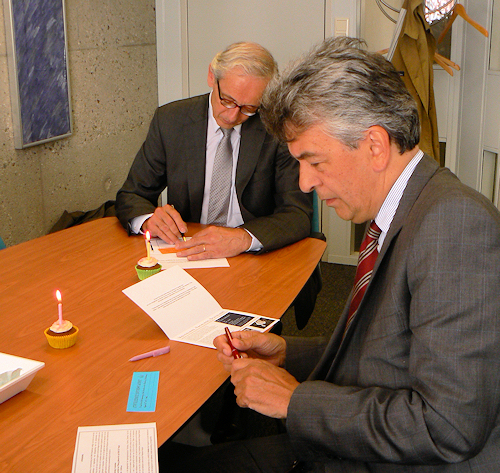
After an evening spent baking and an early morning start, the 50th anniversary of the Convention on the Reduction of Statelessness Birthday Wishes Tour finally kicked off in Utrecht. The eager team of four, two from the Tilburg law School Statelessness Programme and two from UNCHR, commenced at 9.30am with a meeting with STIL, a local NGO that provides support to stateless individuals. We then continued on to the Landelijke Ongedocumenteerden Steunpunt (national foundation supporting undocumented people), where we were presented with an exceptional, hand-made birthday card in honour of the anniversary. Here, Evelien Vehof, one of the journalist behind the Citizens of Nowhere project, also joined us to make a wish. Spending the morning with individuals who work on the ground providing social support and highlighting the plight of stateless persons gave us our initial insight into the eagerness of the people working directly on the issue to push the agenda of combating statelessness forward. 

With the birthday cupcakes delicious reputation developing and some poignant birthday wishes gathered, we left Utrecht (on time!) making our way to the next stop; Amsterdam. We commenced our tour in the capital meeting with Vluchtelingenwerk, Hamerslag & van Haren lawyers and Amnesty International. These three organizations, already involved in advocacy and research on stateless groups and issues related to them, all showed their commitment to be involved in a unified national effort in working on the issue in the near-future. Eduard Nazarski, Director of Amnesty in the Netherlands, summed up the overall sentiment well in his wish… “that governments combat statelessness – everyone has the right to a nationality!”

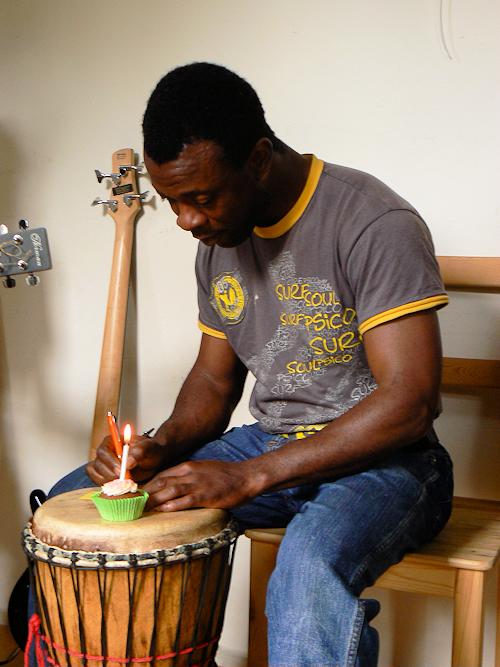
Dokters van de Werald then went on to give us an interesting perspective on the difficulties of stateless groups accessing basic medical rights, and added their wish to the growing pile.  We were then extremely surprised to be treated to music, song and dance by the people at the Wereldhuis, our last stop in Amsterdam, who we were very sad to leave.  Here we were privileged to meet a committed group of individuals providing help to anyone who needed it in their community, regardless of nationality or legal status, and to meet several stateless people who had themselves suffered from the inaction of the authorities to solve their situation. 

After fewer than eight – rather rushed, cake-filled meetings - we were already developing a more detailed picture of statelessness in the Netherlands. The mix of organizations we were meeting with, lawyers working on individual cases, international NGOs with an understanding of the global phenomenon, and community support organizations that helped us put faces and real-life stories behind this universal problem, were together sketching a colourful map of the problems stateless groups face and the steps needed to help.

The genuine enthusiasm and commitment of the people we were meeting provided the energy the team needed to continue the frenzied tour. So, despite hunger kicking in, there was no time to waste as we re-bundled into the car where our dedicated volunteer driver navigated us towards The Hague - to everyone’s surprise – only very slightly behind schedule.

We started our stay in the Hague at the Ministry of Foreign Affairs where we met jointly with Lionel Veer, the Dutch Human Rights Ambassador, and Willem van Genugten, the dean of Tilburg Law School (which hosts the Statelessness Programme). We were very pleased with the interest they showed in the ongoing research initiatives on statelessness and to hear them pledge their support for furthering the advocacy efforts that will stem from the research done in this field. Underway to a brief stop at UNHCR’s own office in the Hague, where we delivered a cake to Rene Bruin, the head of office, we added to our growing collection of hopes and aspirations a number of birthday wishes that were being sent in from people abroad who were not able to join us in the tour.

We were then pleased to be received by Jan Pronk, former Development Cooperation Minister and UN Special Representative in Sudan at his home. We sat with him and his wife in their delightful garden, discussing at some length the legal limbo that stateless individuals find themselves.  We  collected their wish and proceeded to end our tour with a warm reception by a team of senior advisors at the OSCE High Commissioner for National Minorities who shared their understanding of issues of stateless communities throughout Europe, adding a new dimension to the otherwise largely Dutch-focused day. The HCNM’s wish: “700,000 stateless persons in the OSCE region are counting on the Statelessness convention to end their exclusion. Ratify and implement it!” 

After this last meeting the birthday wishes campaign continued with the team collapsing in a café and finally blowing out their own candles, tasting the cupcakes and making their own wishes. All involved were genuinely surprised and gratified by the reception and passion we repeatedly met over the course of our frantic day on the road.  It was clear that the issue of statelessness was a rising and enduring concern for those we met, while advocacy opportunities were disappointingly limited due to a lack of information on the overall situation in the country and of awareness of the issue generally. 

Everyone encountered was furthermore keen to join the Statelessness Programme in their official launching event, Voiceless, Faceless, Stateless, which will be the next step in raising awareness of the issue and further strengthening ties between the organizations involved in order to advance efforts on all levels.  This will be held on November 3rd and will also be a good opportunity to discuss the findings of the UNCHR report which details the humanitarian and legal situation of statelessness in the Netherlands, which will be officially launched on October 31st.  All the organizations, through their own capacity, have been dealing with issues of statelessness, and all were confronted with obstacles while trying to address the problem.  This varied from finding difficulties in helping stateless children access vaccination programmes in Rotterdam to dialogue on how the ‘’legal stay’ requirement in Dutch law which violated the very convention we were celebrating was obstructing legal solutions. These and other topics were noted down for the agenda of future meetings with to discuss in greater depth what response is needed to better address statelessness in the Netherlands.
 
The only regret of the day was that we were not able to spend more time talking to and learning from the individuals and organizations we met. This will have to wait until the next opportunity to sit around a table with one another, perhaps over more cake, as we take the next step in the challenging journey towards tackling statelessness and turning some of these wishes into reality. Watch this space as the journey continues…


For your enjoyment: a list of all the wishes collected!

Wishes from around the Netherlands on 30 August 2011

OCSE High Commissioner on National minorities (The Hague)
I wish… 700,000 stateless persons in the OSCE region are counting on the Statelessness convention to end their exclusion. Ratify and implement it!

Amnesty International (Amsterdam)
Eduard Nazarski: I wish… Governments would combat statelessness. Every individual has a right to a nationality!
Annemarie Busser: I wish… Nationality forms the access to a lot of fundamental human rights; stateless people should never be put in immigration detention

Jan Pronk (The Hague)
I wish… The Netherlands government complying with the 1961 Convention, and strip the legal stay condition

Evelien Vehof, Citizens of Nowhere (Utrecht)I wish… For nation states to use their power to take care of the stateless and recognize then as citizens

Dutch Refugee Council (Amsterdam)
I wish… Its about people, not about borders! Don’t let people be the victims of conflicts between states!

Lionel Veer, Human Rights Ambassador of the Netherlands (The Hague)
I wish… This campaign will help solve the problem and help the ‘victims’

UNHCR (The Hague)
I wish… All Stateless persons be recognized and can start life again

Landelijk Ongedocumenteerden Steunpunt (Utrecht)
That the statelessness convention will be used more effectively in the Netherlands.

Dokters van de Wereld (Amsterdam)
I wish… That stateless have better access to health, more info that stateless children have the right to be vaccinated

Willem Van Genugten, Tilburg Law School (The Hague)
I wish… That much more attention will be given to an much more REAL ACTION will be undertaken in order to tackle the problem

STIL (Utrecht)
I wish… That statelessness soon only means there are no more states. No one is illegal!

Neil Blomhous, Lawyer with Hamerslag & van Haren (Amsterdam)
I wish… That the Dutch authorities would approach the problem of statelessness with an attitude towards solving the problem instead of dumping it on the (de facto) stateless person


International Organisation for Migration (The Hague)
I wish… that all countries become signatory and abide to the convention of 1954 relating to the Status of Statelessness Persons and the convention of 1961 on the Reduction of Statelessness
  
Wishes collected at the Wereldhuis (Amsterdam), including from stateless people

I wish… All humans to be respected as such, regardless of their nationality or beliefs

I wish… That one day we all walk through boundaries without any questions of documents but love

I wish… The Dutch government fulfils her noble promise in allowing the statelessness sufferings and see them not as numbers but as human beings!

I wish… The statelessness people will be recognized to be known to enjoy a better life at wherever countries they are in

I wish… That justice will always exist

I wish… The Netherlands can become a home country for these people who are stuck here because no country accepts them

 
Wishes from the ‘birthday wishes campaign team’

Femke Joordens, UNHCR Nederland
I wish… No country should tolerate that children are born stateless 

Laura van Waas, Statelessness Programme
I wish… That over 100 states pledge to concrete action to address statelessness at the ministerial conference this December

Zahra Albarazi, Statelessness Programme
I wish… That states recognise and ensure the fundamental human rights of stateless persons and not see nationality as prerequisite for enjoying rights

Karel Hendriks, statelessness researcher for UNHCR
I wish… That all states would establish a dedicated statelessness procedure. After all, statelessness is a legal fact

Mark van Waas, dedicated driver for the campaign
I wish… That states who don’t feel statelessness is a big issue wake up and tackle the issue
 

Wishes sent in from others around the world

Sebastian Kohn, OSI (New York)
I wish… To end statelessness amongst children through committed law and policy
reforms. And follow @statelessness

Amal Dechickera, Equal rights trust (London)
I wish… Reduction of statelessness is as important today as it was 50 years ago. We wish that in 50 years time there will be no need for a convention.

Praxis (Serbia)
I wish… Every person in the world could have a state!

Nick Oakeshott, Asylum Aid (London)
I wish… That all European states establish Statelessness Determination procedures following the excellent examples set by France and Spain.

Priyanka Motaparthy, HRW (New York)
I wish… For stateless biduns in Kuwait, after fifty years of waiting, to get citizenship through a fair and just procedure.

Maureen Lynch, International Observatory on Statelessness
I wish… This anniversary year, equal attention and efforts would be paid to ensuring nationality rights for all the worlds stateless people.

Cynthia Morel, Independent Consultant working on nationality
Over the course of the last 50 years, the Convention has enabled countless individuals to shed the shackles of statelessness, leading to full and fruitful lives. While this anniversary is cause for optimism, let us not forget the millions who remain at the margins of society, in desperate need of recognition.

Campaign tools: cake and explanatory card

Eduard Nazarski, Amnesty International

Jan Pronk, former Dev. Coop. Minister

Human Rights Ambassador Lionel Veer and Tilburg Law School's Willem van Genugten

A beautiful card hand-crafted by the staff at LOS in Utrecht

Mirjam Koppe, Dokters van de Wereld

Staff at the OSCE High Commissioner for National Minorities

Wishes and music greeted us at the Wereldhuis in Amsterdam