Showing posts with label Bangladesh. Show all posts

Thursday, 11 September 2014

GUEST POST: Community Paralegals and the Legal Empowerment Approach to Statelessness

Mohammad Javed is an Urdu-speaking entrepreneur living in the middle of Dhaka, the capital city of Bangladesh. Looking to grow his business, Mohammad decided to travel to India to start importing spare auto-rickshaw parts for his own repairs and to sell to others. Yet Mohammad was unsure of the process through which he could obtain a passport. He was also intimidated to approach the passport authority office. While a landmark 2008 High Court judgment confirmed Urdu-speakers’ Bangladeshi citizenship and ended their 40 year struggle with statelessness, Mohammad had heard stories of fellow Urdu-speakers being denied passports due to their identity and residence in urban “camps” established by the ICRC after Bangladesh became independent in 1971.

A continent away, Yusuf is a 19-year-old of Nubian ethnicity living in the Kibera slum outside Nairobi, Kenya. Yusuf wanted a birth certificate to access basic services and to reinforce his identity as a Kenyan citizen. For three months, he tried to apply for a birth certificate on his own. He repeatedly went to the relevant government office, which required a trip into town, but each attempt to apply was met with harsh treatment and requests for additional supporting documents beyond those required of most Kenyans. After many failed attempts, Yusuf gave up on getting a birth certificate.

Both Mohammad and Yusuf belong to minority groups that are either emerging from a protracted situation of statelessness or are at risk of statelessness due to difficulties in acquiring legal identity documents like ID cards and passports.  Despite laws and court decisions that establish their citizenship rights, lack of legal knowledge, complex application procedures, and a lack of proper implementation of the law – sometimes outright discrimination – all stand in the way. 
How, then, can Mohammad, Yusuf, and the millions of others like them around the world protect their rights as citizens – obtaining legal identity documents that allow them to prove their nationality, obtain employment, travel abroad, open a bank account, or enroll in school?

Community-based paralegals, also known as grassroots legal advocates, can bridge the gap between law and real life. They use knowledge of law and government, and skills like mediation, education, organizing, and advocacy to seek concrete solutions to instances of injustice. Paralegals not only work alongside clients to resolve a legal issue, but also focus on empowerment -  leaving each client in a stronger position to deal with similar problems in the future.
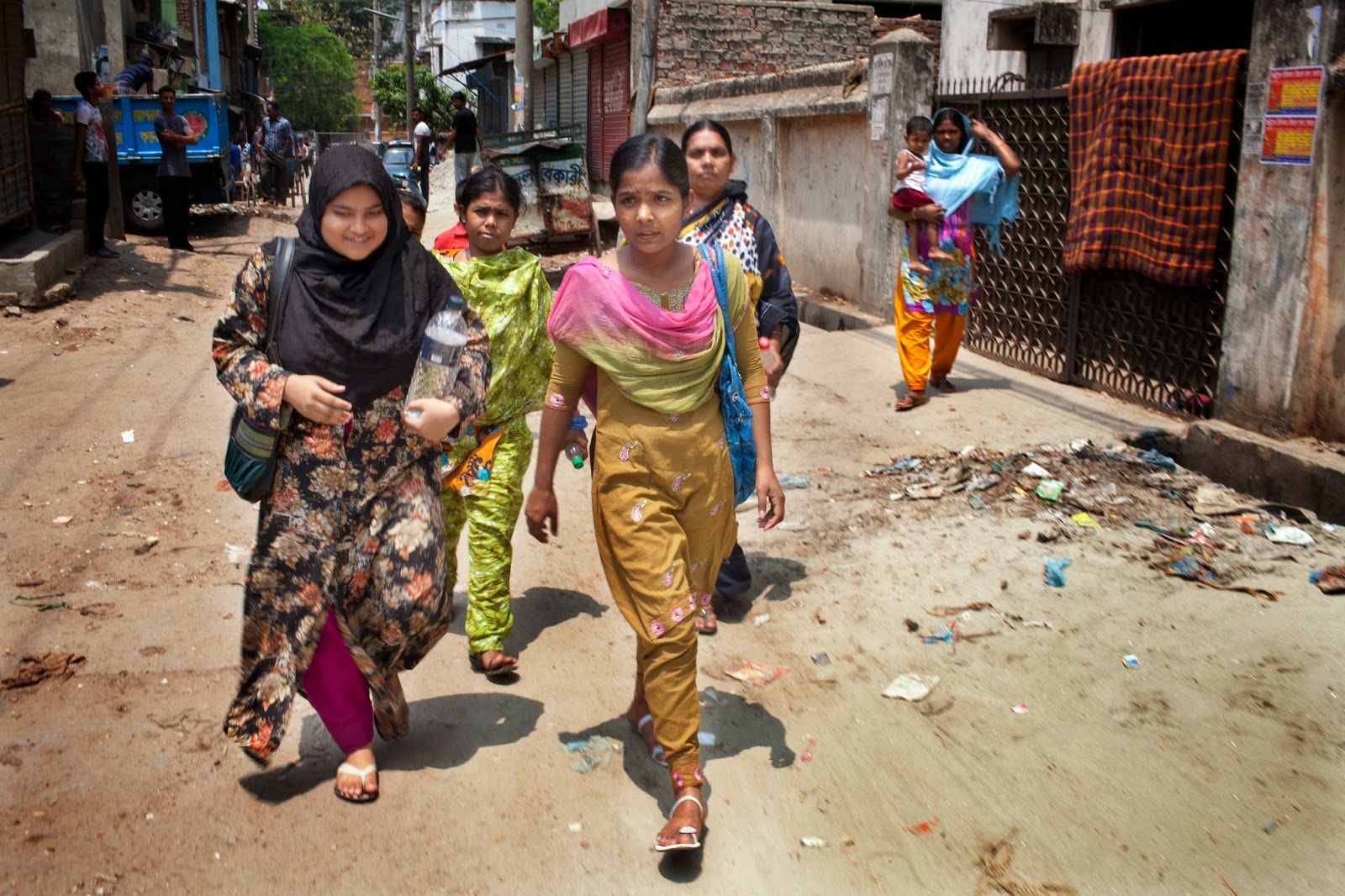
In Bangladesh, paralegal Nahid Parvin from the Urdu-speaking community
accompanies a client to a Government registration office
Namati, an international legal empowerment organization, is dedicated to the paralegal approach. Since 2013, Namati has been working with Nubian Rights Forum and the Open Society Justice Initiative (OSJI) in Kenya and with the Council of Minorities in Bangladesh to train and support paralegals in communities emerging from or at risk of statelessness.

The Nubian paralegals in Kenya and the Urdu-speaking paralegals in Bangladesh start by educating their communities about the importance of legal identity documents, the eligibility requirements and application processes.

Some people use that information to apply on their own. Others require additional assistance – help with forms, or a paralegal to accompany them to the registration office.  Sometimes the paralegal’s presence alone will make an official think twice before making extra-legal requests. And when an official delays or denies a client’s application for an identity document, the paralegal is there to use the law in negotiations and follow the case through to a resolution.

In the past 18 months, Nubian Rights Forum paralegals have opened over 1,200 cases and several hundred clients have already received their identity documents. In Bangladesh, more than 1,400 Urdu-speaking clients have received identity documents in just one year.

Yet the paralegals supported by Namati and its partners are not only concerned with assisting individual clients. The paralegals are tracking every case to establish an evidence base on how laws are implemented. By analyzing hundreds of cases, the data can be used for high-level advocacy.  Improvements to the law and practice can create change not only for Kenyan Nubians or Urdu-speaking Bangladeshis, but potentially ease access to legal identity documents to all citizens in these two countries.

And as this model of citizenship-focused paralegal services develops, practical resources and lessons will be shared with like-minded organizations, illustrating how community-based justice services can respond to or prevent statelessness around the globe.

This Guest Post was written by Laura Goodwin, Program Director at Namati (www.namati.org). She manages Namati’s Burma Program and Citizenship Program, which is active in Bangladesh and Kenya. She is speaking at the Global Forum on Statelessness on Monday 15 September.

Friday, 29 June 2012

Statelessness in 2012: one step forward, two steps back?

The year 2011 ended on an unmistakable high in terms of momentum to address statelessness worldwide, with the issue somewhat stealing the show at UNHCR’s December Inter-ministerial meeting, as one state after another affirmed the importance of tackling the problem and pledged to take action. Entering the new year, things were still looking promising with a number of countries in Africa, Europe and the Americas already making good on their promises and acceding to one or other - or both - of the statelessness conventions, or taking steps to introduce a statelessness determination procedure in their legal system. 

Meanwhile, in early 2012, the newly elected Council of Europe Commissioner for Human Rights, Nils Muižnieks, indicated his intention to continue his predecessor's work in highlighting problems of statelessness across the continent and expressed a particular interest in raising the issue of stateless children. Europe also saw the launch of the European Network on Statelessness at the start of June 2012: the first significant regional initiative by civil society to collaborate closely in order to 'strengthen the often unheard voice of stateless persons and to advocate for full respect of their human rights'. And Slovenia's "erased" have just won a landmark victory before the European Court of Human Rights' Grand Chamber, which ruled that the government's deletion of some 18,000 names from the civil registry books in 1992 - which left people both stateless and classed as illegal residents - was a violation of the right to family life (article 8 ECHR) and the principle of non-discrimination (article 14 ECHR). This case, Kuric v. Slovenia, provides crucial confirmation of the European court's competence to rule on matters relating to the enjoyment of nationality - given the right circumstances of the case - and its interest in acting on statelessness.

Each of the developments noted above - and more besides - constitutes an important step forwards in addressing statelessness and demonstrates that the issue is now, at last, receiving significant international attention. Yet, if we flip the coin over, the other side exposes some extremely disquieting statelessness-related developments. From Sudan/South Sudan, UAE, Syria, Dominican Republic, Libya and elsewhere comes news of emerging cases of statelessness and/or further stagnation or deterioration of the situation of stateless people. 

Most worrying of all - and distressing enough to take the shine off any global efforts towards the resolution of statelessness - is the news from Myanmar (Burma). For several weeks now, reports pouring out of the country have brought word of an ever-worsening situation for the stateless Muslim minority in Myanmar's Rakhine state, the Rohingya. What was initially described as a flare of ethnic tension has since deteriorated into shocking reports of killings, the destruction of tens of thousands of homes and the displacement of tens of thousands of people. Those attempting to flee the violence by sea are meeting perhaps even greater risks on their perilous journey, with reports of helicopters firing on boats full of these stateless refugees (including children). And those that do make it to shore in neighbouring Bangladesh being turned back out to sea in their overloaded boats with only a small supply of fresh of water and rice or bread as this news footage shows. 

While the recent moves towards a more democratic state have cast a positive light on the future of Myanmar and Aung San Suu Kyi's recent international tour - a highlight of which was her acceptance of the Nobel Peace Prize awarded to her in 1991 - has inspired hope in many, the situation of the stateless Rohingya does not look set to benefit from these developments any time soon. Indeed, Suu Kyi herself has declared that she "does not know" if the Rohingya should be regarded as Burmese and now a group of eight ethnic parties allied with Myanmar's opposition movement has rejected the idea that the Rohingya should be recognised as one of the country's ethnic minorities. There is no doubt that the current treatment of the Rohingya both inside Myanmar and as hundreds seek protection abroad is casting a deep and worrying shadow on international developments in the field of statelessness in 2012. 

Laura van Waas, Senior Researcher and Manager, Statelessness Programme

Wednesday, 20 July 2011

A state, within a state, within a state...

There’s a curious place you can visit, just a short stretch down the road from where the Statelessness Programme has its office in Tilburg. It’s called Baarle-Hertog and it’s a little patch of Belgium, entirely encircled by territory of the Netherlands. Then, inside this patch of Belgian soil, is another, smaller plot of land which is once again a part of the Netherlands, but cut off from the rest of the country completely by the area of Belgian territory. A state, within a state, within a state. Arising many centuries ago as a result of various treaties, land swaps and sales, it is an anomaly which, much to the bewilderment of many, has defied all efforts at being corrected. Over time, successive attempts to create a more regular border situation – including as recently as 1996 – were thwarted, thanks in part to the strong sentiment of proud residents in favour of maintaining the status quo. Today, with both Belgium and the Netherlands enveloped by the European Union, this geopolitical curiosity has little real significance and it serves largely as something of a tourist attraction.

Half-way around the world, in South Asia, we find a similar geopolitical anomaly of far greater significance. The border region of India and Bangladesh, in the districts of Cooch Behar and Jalpaiguri, is dotted with its own series of enclaves – little patches of one state that are surrounded by the territory of the other. The scale of the situation is impressive: although exact figures differ from one source to another, it appears that there are over 100 Indian enclaves in Bangladeshi territory and more than 50 Bangladeshi enclaves in Indian soil. Here, too, there are also some enclaves within enclaves, such as the Bangladeshi sub-enclave of Haluapara that is surrounded by the Indian enclave of Garati, in turn encircled by Bangladesh. For over fifty years, India and Bangladesh (previously East Pakistan), have intermittently and unsuccessfully discussed the exchange of these enclaves and the normalisation of the border. In 1974, an agreement was even reached about a land swap to resolve the situation of the enclaves, but this was never implemented. All the while, the tens of thousands of residents of both sets of enclaves have been left much to their own devices, their physical separation from the mainland state resulting in them becoming cut off from regular government services. Infrastructure (e.g. roads, postal service and electricity), healthcare, education, markets/trade, law enforcement, tax collection and politics – none reach effectively across the foreign divide from the mainland state and into the enclaves. Even travelling from the enclave to the mainland state became a real challenge when passport and visa systems were introduced but no provision was made for passport offices within the enclaves to issue documents to residents, forcing them to cross borders illegally just to file a passport application in their own state.

As one study summarised, the enclaves formed an “archipelago of stateless territories” and the inhabitants themselves have been described by numerous observers as stateless. Indeed, if their lives are untouched by their purported country of nationality due to the absence of any functions of the state in their place of residence and their inability to travel to the mainland state, perhaps there is no “state” which considers them as nationals and they could in fact be identified as stateless. Or perhaps they are not truly “considered as” nationals, given that they have been left stranded in their enclave with little to no interaction with the state. [A stateless person is someone who is not considered as a national by any state under the operation of its law]. It’s certainly the case that the peculiarities of their situation raise some fundamental questions about the meaning of statehood, the content of nationality and the interpretation of various components of the definition of statelessness.

Today, the Indian and Bangladeshi enclaves are making international headlines because the two countries seem to be taking unprecedented steps towards a resolution of the situation. This month, the first ever joint census of the population of the enclaves is being carried out, to get a complete picture of how many people live in these patches of territory. It looks as though, when the countries’ leaders next meet, the proposal of a land-swap or other settlement for this anomaly will be back on the agenda. If and when this does happen, the repositioning of the borders will inevitably lead to new questions about the nationality of those who live in these areas. As with all situations where sovereignty over a plot of land is passed from one state to another, the matter of citizenship will have to be carefully coordinated in order to ensure that no-one is left stateless. It would be a sad state of affairs indeed if normal state functions and services are finally secured for the enclaves, only to now leave the people without citizenship or forced to relocate in order to continue to enjoy a nationality.


Laura van Waas, Senior Researcher and Manager, Statelessness Programme